Sunday, March 02, 2008

Google Sites: Collaboration from Google

Need to create a team site to centralize all types of data and information (think wiki)? Check out Google Sites a part of Google Apps. Here is Google's short summary of what it does:
Google Sites makes creating a team web site as easy as editing a document. You can quickly gather a variety of information in one place — including videos, calendars, presentations, attachments, and gadgets — and easily share it for viewing or editing with a small group, your entire organization, or the world.
I yet to try out the features -- but plan to test it for a couple of projects. I'm interested in thinking (and hearing from others) about how law firms and lawyers can use this technology service.

A review of Google Sites with more in depth discussion of the features. Business Week, VentureBeat and others cover the release of Google Sites.

Wednesday, February 27, 2008

HITCHtv: HIPAA Fun and HIStalk HISsies Awards 2008

Who says HIPAA law and health care technology (aka e-lectric-medical records) are boring topics. Health IT can be fun!


If you are missing HIMSS08, check out the HIStalk HISsies Awards 2008 (video) courtesy of the Healthcare IT Transition Group and HITCHtv. Great stuff for those interested in the best and worst of Health IT (or as Mr. HIStalk prefers HIS).

dCard: Health 2.0 Group Releases Standard for Physician Information

My health colleagues over at change:health (Christopher and Robert) and Organized Wisdom (Steve and Unity) along with Within3, the founding members, have worked together to release a new open standard dCard (doctor card) to establish basic e-standards for the collecting, storing and sharing of physician information. The dCard is also designed as a central location for the physician to maintain their core data and information.

The dCard concept is being initially supported by a group of nine health care technology companies. As the change:health press release indicates, joining them are eight other companies working together to develop the dCard:
  • Within3 (Online professional network for health science professionals and organizations)
  • OrganizedWisdom Health (First human-powered, physician-reviewed search service for health information, products and services on the web)
  • VerusMed (Providers of clinical briefs for 150,000+ physicians and healthcare professionals)
  • Peerclip (Online tool that enables physicians to organize, share, discuss and discover relevant medical information)
  • Ozmosis (Online platform that unites physicians and healthcare organizations in a collaborative environment to improve patient care)
  • Enurgi (Online healthcare services company that connects families and patients-in-need with 1 million+ local, clinical caregivers across the country)
  • J. Parkinson, M.D. (Leading healthcare consumerism advocate and New York-based family practice physician)
  • ReliefInsite (Secure, online pain management services)
I'm looking forward to learning more about the format and concept as the work to define the standard continues. Read more about the development of the dCard effort via VentureBeat and the press (change:health blog post). More from Unity Stokes at Organized Wisdom here.

Note: Not to be confused with this D-Card - but the entire industry could learn a lot from the Big D (see this post). Great step forward by this group. Christopher, you understand - I'm just returning from the land of Animal Kingdom and Magical Kingdoms and still not back in reality.

Tuesday, February 26, 2008

The Blogger Eye View of HIMSS Orlando

Jay Parkinson and Scott Shreeve give those of us not attending a glimpse into the happenings at HIMSS Orlando. I particularly enjoyed Dr. Parkinson's round soap theory of health care IT. For more from HIMSS check out HIStalk.

As I travel I aways wonder what happens to all the "once used" soaps. Do they just re-wrap them?

Sunday, February 24, 2008

Google Health: Google Partners with Cleveland Clinic

The New York Times Technology Section reports on a pilot project between Gooogle and the Cleveland Clinic in an article, Google to Store Patients' Health Records.

The article indicates the pilot project will involve a volunteer patient group transferring their personal health records so that they are available via Google Health, a new health record product being developed by Google. The article quotes Pam Dixon of the World Privacy Forum concerning privacy issues under HIPAA (incorrectly referenced by the Times as HIPPA).

I don't necessarily agree with the scope of the comments regarding the applicability of HIPAA in this situation. Although I don't know the full details of the relationship for the proposed project but it would appear that Google in this situation might be serving as a business associate of the Cleveland Clinic for the project. As a business associate it is likely that Google would be held contractually to many of the HIPAA privacy standards.

Tip to Matthew Holt at Health 2.0 Blog for noticing the NYT article.

UPDATE (2/22/08): ZDNet's Larry Dignan at Between the Lines has more on the pilot project including the Cleveland Clinic's press release.

The comments to Dignan's post are interesting reading especially a couple with a legal perspective. The comment, two misconceptions, highlights the overall light enforcement efforts by OCR and lack of penalties, whether Google might fit the "healthcare clearinghouse" definition under the "covered entity" definition, entering into a contract with the health care provider (business associate requirement) and discusses the subpeona and marketing misconceptions.

Also, more from NYT's Steve Lohr, Google Health Begins Its Preseason at Cleveland Clinic which indicates that Google Health will be made available to the public following completion of the pilot project (appoximately 2 months). The article also has a quote from fellow health care blogger and CIO of Beth Israel Deaconess Medical Center in Boston, John Halamka, who indicates that the hospital is also interested in linking its EMR with Google Health. As a board member of the West Virginia Health Information Network I would like to explore the idea of utilizing and integrating Google Health into our statewide effort to bring about an integrated/interoperable health information system.

Jane Sarasohn-Kahn at HealthPopuli shares her thoughts and additional link commentary on the Google/Cleveland Clinic project. Jane highlights a recent report, Personal Health Records: Why Many PHRs Threaten Privacy, by the World Privacy Forum looking into privacy issues for PHRs.

Matthew Holt's follow up post taking a closer glimpse at the privacy questions, motives and opportunities both pro/con surrounding the Google Health project.

UPDATE (2/24/08): For the latest article covering the Google Health project check out Newsweek's article, Web Surfer, Health Thyself, out in the March 3 edition.

Also, MSNBC provides some additional insight on how Google Health will interact with the existing Cleveland Clinic EHR (or PHR) in Google Goes to the Doc's Office. The article describes the pilot project as follows:
. . . The Cleveland Clinic already keeps electronic records for all its patients. The system has built-in smarts, so that it will alert doctors about possible drug interactions or when it's time for, say, the next mammogram. In addition, 120,000 patients have signed up for a service called eCleveland Clinic MyChart, which lets patients access their own information on a secure Web site and electronically renew prescriptions and make appointments.

The system has dramatically cut the number of routine calls to the doctor and boosted productivity, though it has yet to effectively deal with information from an outside physician, Harris says. Those records are typically still on paper, and have to be laboriously added to the Cleveland Clinic system. It is a big problem, especially for the clinic's many patients who spend winters in Florida or Arizona, where they see other doctors.

Adding Google's technology lets patients jump from their MyChart page to a Google account. Once on Google, they'll see the relevant health plans and doctors that also keep electronic medical records. That means the patient can choose to share information between, say, the Arizona doctor and the Cleveland Clinic . . .

UPDATED 2/26/08: Scott Shreeve goes Giga over Google Health. Read his first impressions of the Google PHR after his test drive at HIMSS.

However, Dmitriy at TrustedMD makes some great points, including this quote:
Yet, even with free PHRs out there, consumers simply do not care for spending their time to learn and use them. Who would bother entering and checking their medical records if you are healthy and would rather go see a movie? And once you get sick, you do not want to enter them either. You just want your doctors and hospitals to hand your medical records to you. But you see, the providers have different priorities that a mere piece of software just cannot solve . . . PHRs' real problems are not technical, usability or even privacy. The real problem is consumer and provider motivation . . .
He ends his posts with some questions we should all be discussing. Until we see a reimbursement model that creates incentives for providers to look at more health information and consumers to care about and take an active part in their health -- I'm not sure the PHR/EHR initiatives will fully develop and mature.

Follow the latest news (blog posts) and the Techmeme reaction to the project.

Tuesday, February 12, 2008

David Harlow's Grand Rounds Gets To the Heart of the Matter

Congrats to fellow health law blogger, David Harlow at HealthBlawg who does a wonderful job weaving together a special Valentine's Day edition of Grand Rounds. David's edition gets to the heart of the matter and includes a wide range of posts - covering the love hormone, the Dead, death from Q-tips, Lupercalia and so much more. Thanks David for including my last minute submission.

AHLA Physicians and Hospital Law Institute

Tomorrow I'm off to attend the American Health Lawyers Association's Physicians and Hospitals Law Institute in Orlando tomorrow. Looking forward to the Florida warmth as the temperature here in West Virginia dips into the single digits tonight.

If your interested in the law of health care the AHLA is the group to join. I highly recommend any of their programs. Good venues, great speakers, good networking and all around first class.

Later in the week my family will be joining me and we plan on enjoying Walt Disney World for a few days. Both my wife and I haven't visited since we were young kids in the 1970s and first visit for our two kids. Everyone is excited.

If any regular readers are attending the AHLA Conference and want to get together send me an email or post a comment.

Thursday, February 07, 2008

Web/Health 2.0 For Dummies

Blogs, wikis, social bookmarking and social networking for dummies courtesy of Pew Trusts' e-patients.net. Simple explanations and visual demonstrations to better understand the basic concepts.

I've watched a couple of these before -- but have not seen a post with them conveniently in one place. Again the power of social networking (e-social improvement courtesy of the grid crowd). Moreover, I didn't really know who produced these short explanatory videos -- check out Common Craft for more videos including on RSS in Plain English.


Hmm . . . I may contact them to help me produce a clip called: Stark Law in Plain English.

Tip to Matthew Holt over at the Health Care Law Blog.

Wednesday, February 06, 2008

CMS Releases New Physician Self Referral (Stark) FAQs

The Centers for Medicare & Medicaid Services (CMS) recently modified its website and included a new Frequently Asked Questions (FAQ) section under the Physician Self Referral (Stark) section. CMS added 12 new Stark FAQs on January 31, 2008. A number of these new FAQs relate to the new Stark III regulations.

Tuesday, February 05, 2008

Grand Rounds: Health 2.0 Explosion At Diabetes Mine

Amy Tenderich of Diabetes Mine explores the Health 2.0 Explosion in this week's edition of Grand Rounds, Vol. 4, No 20. If you are interested in health care social networking and health 2.0 topics don't miss reading this week's edition.

Great job Amy!

Saturday, February 02, 2008

Hospitals and Anonymous Blogging: An Update of the Paris Regional Medical Center Lawsuit

Just pick up the latest news from Greg Piche of the Holland & Hart Healthcare Law Blog about the pending libel lawsuit against an anonymous blogger filed by Paris Regional Medical Center, a subsidiary of Essent. For some background on the case check out Jeff Drummond's past post Hospital Sues Blogger.

The libel lawsuit filed last year by Paris Regional Medical Center seeks the unmasking of an anonymous blogger and nine other anonymous contributors or commentators on his/her blog.

The hospital sought the identity of the anonymous bloggers from Suddenlink who balked at disclosing the identity of the anonymous blogger until he/she was given notice and an opportunity to object. As a result the anonymous blogger appeared through an attorney and objected which were rejected by the trial court.

However, on appeal to the Court of Appeals for the Sixth Appellate District of Texas at Texarkana, In re: Does 1-10, No. 06-07-00123-CV (Dec 12, 2007) followed the standard set out in Doe. V. Cahill, 884 A 2d 451 (De. 2005), granted the writ of mandamus and ordered the trial court to vacate its order requiring Suddenlink to disclose the name and address of the anonymous blogger. Basically, the court sustained the anonymous bloggers First Amendment rights of free speech until such time as the hopsital can show in a hearing at the trial court level that it has actually been damaged by the content of the blog.

The court analyzed the situation as follows:

The cases that have decided this issue range from placing an extremely light burden (indeed, virtually no burden at all) on the plaintiff, to requiring the plaintiff to tender proof of its allegations that would survive a summary judgment, or even more stringent requirements. At least one case has essentially concluded that the mere allegation of libel is sufficient. Alvis Coatings, Inc. v. John Does One Through Ten, No. 3:04CV374-H, 2004 U.S. Dist. LEXIS 30099 (W.D.N.C. Dec. 2, 2004). Other cases have articulated requirements that are so weak as to essentially require no more than allegations made in good faith (or not in bad faith), with some evidence to support the allegations. See Polito, 2004 Pa. Dist. & Cnty. Dec. LEXIS 340.

We cannot agree that either of these formulations is sufficient to survive any form of constitutional balancing. Thus, the question becomes the degree of actual proof that must be provided before the balance tips in favor of piercing the constitutional shield and disclosing the identity of the anonymous blogger.

We find ourselves more in alignment with the formulations set out in Cahill, 884 A.2d at 458-61. See extensive discussion about the application of this standard in Best W. Int'l, 2006 WL 2091695. The court in Cahill described the test as: "[B]efore a defamation plaintiff can obtain the identity of an anonymous defendant through the compulsory discovery process he must support his defamation claim with facts sufficient to defeat a summary judgment motion." Cahill, 884 A.2d at 460. This standard does not require a plaintiff to prove its case as a matter of undisputed fact, but instead to produce evidence sufficient to create issues that would preclude summary judgment.

Thursday, January 31, 2008

West Virginia E-Prescribing Regulations

On January 4, 2008, the West Virginia Board of Pharmacy filed a Notice of Emergency Rule amending CSR 15-1, Licensure and Practice of Pharmacy, implementing the requirements of SB 1001 (See SB 69 and HB 2289) passed during the 2007 Legislative Session permitting electronic prescribing (e-prescribing) of legend drugs in West Virginia, including through the use of electronic data intermediaries.

The Board also filed on January 4, 2008, the Notice of a Comment Period on a Proposed Rule amending CSR 15-1, Licensure and Practice of Pharmacy. Comments on the Proposed Rule must be submitted before February 8, 2008.

The summary and statement of circumstances included in the notice reads:
SB 1001, passed during the First Special Session, 2007, and duly enacted into law, permits electronic prescribing (e-prescribing) of legend drugs in this State, including through the use of electronic data intermediaries as defined therein. SB 1001 contains the following directive to the West Virginia Board of Pharmacy as set forth in West Virginia Code Section 30-5-12C(d): "The board shall promulgate emergency rules pursuant to the provisions of article three, chapter twenty-nine-a of this code to implement and enforce the provisions of this section." E-prescribing is already being done by prescribers around the state, with the amount and frequency of electronic prescriptions being received by pharmacies increasing each day as the technology becomes more accepted and available in the industry. While the current rules allowed for electronic transmission of prescriptions, SB 1001 states that e-prescribing may not be done in this State until emergency rules are promulgated, and further sets additional parameters defining this growing area. As such, the e-prescribing currently being done in this State is being done without appropriate legislative rules in place to protect the integrity, privacy, security and confidentiality of the prescription orders. In addition, prescription drug diversion is an ongoing problem in this State and nation; e-prescribing done correctly is one method to combat the problem often perpetrated through passing fraudulent written prescriptions. Finally, e-prescribing aids in the accuracy of prescriptions by more timely presenting them electronically from the prescriber's office to the pharmacy in a clearly legible format, thus reducing fill-errors and facilitating patient compliance with the prescribed treatment.

Given these factors, the Legislature, through its deliberative process, has determined that an emergency exists requiring the need for emergency rules to govern the use of e-prescribing and electronic data intermediaries in this State for patients to access prescription medications in a safe and efficient manner. Therefore, in accordance with that directive, the purpose of this emergency rule is to revise existing rules governing issuance of prescription orders to set specific standards to govern e-prescribing in West Virginia, thereby protecting the public health, safety, and welfare with regard to restricted drugs which may only be obtained by patients with a proper prescription.

Wednesday, January 30, 2008

Results of Tech President Primary

Want to know where the presidential hopefuls stand on technology?

Check ou the result of the TechCrunch Tech President Primaries. You can see where the candidates stand on 10 key tech issues. Based on the results the TechCrunch endorsements goes to Barack Obama and John McCain.

Great information if you are concerned about the level of knowledge our leaders must have regarding the importance of technology on the economy and our culture.

Tuesday, January 29, 2008

Grand Rounds . . . Revolution

Grand Rounds Volume 4, No. 19 is up over at my favorite nurse blog, Emergiblog. Kim has wonderful vision into the world of health care and is a creative writer to boot.

I've gotten out of the habit of submitting posts to Grand Rounds. Never enough time in the day. However, I wish I would have submitted my Guitar Hero Health Care post from this week -- it would have fit well in her Beatles theme. Find the Beatles link in my post.

Maybe I'll email Kim as see if she will give me a Grand Rounds postscript note.

West Virginia Educational Social Network

The State Journal reports that West Virginia University with the backing of a grant from Verizon will create a social network for middle and high school students focused around education (with emphasis on the energy sector) to get a head start on career decisions.

Partners in the project include WVU's College of Engineering and Mineral Resources, College of Human Resources and Education and The EdVenture Group.

A description of the project from the WVU press release:

Unlike Facebook.com and other social networking sites, the new site, once developed, will not be open to the general public. Rather, a network of representatives from participating companies and schools will serve as experts and mentors for students who join the site.

Along with Web-based interaction within groups, the site will host discussion groups, chats and blogs on relevant topics and an “Ask the Counselor” section where students can ask questions concerning academic or career issues. Other activities may include contests based on career knowledge, virtual career fairs and group visits to employer or educational facilities.

Interesting concept and I'm excited to learn more about the project. Based on my experience with social networking and the use of blogs in the legal industry I think the application of these technologies in education can be powerful. The added plus is that the platform will be familiar and attractive to the way that middle and high school students communicate. Anyone aware of similar projects like this happening around the country?

I will be interested to hear what Lee Kraus, the guru on education focused social networking, has to say about the pilot project. This reminds me of a concept that I previously discussed with Lee.

WVU press release has more details.

Saturday, January 26, 2008

Newsweek Features Amy Tenderich of DiabetesMine

Great to see Newsweek run a story on Amy Tenderich and the success of her blog, DiabetesMine. Amy's efforts are a great example of how blogs can be used to creatively share valuable information with a patient community.

Here is a taste of the article and how Amy got started,

I've been writing my Web site for three years now, and some amazing things have happened. First, I learned all sorts of facts about my own health that doctors never told me. I learned that thousands of other people out there have been diagnosed with type 1 diabetes later in life, like me—a condition called LADA (latent autoimmune diabetes in adults). From other patients I also learned essential basics about related conditions, like gluten intolerance (celiac disease), and Raynaud's syndrome, a circulation disorder in the hands—both of which I suffer from, along with the diabetes.

Second, a whole community of "patient bloggers" has grown up around me—hundreds of other people sharing their health challenges on the Web. We exchange treatment and insurance tips, hold online chats, link to each other's sites, and even manage to meet in person sometimes.

Congrats Amy on a great article.

Friday, January 25, 2008

Get Your Google Health . . . Soon

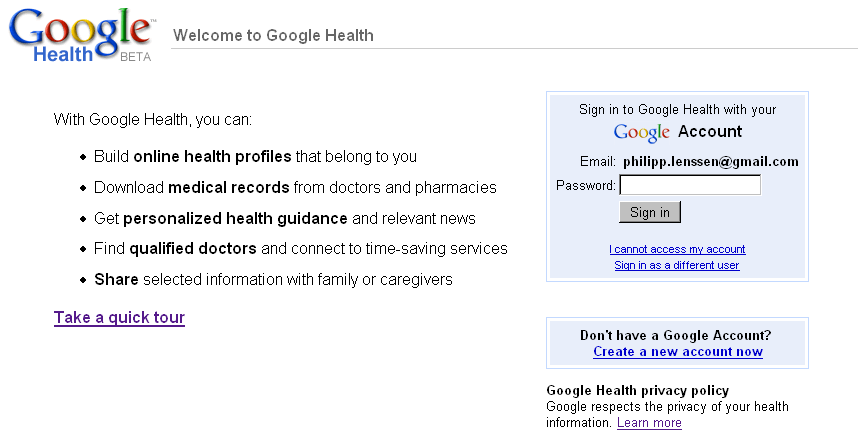
Various reports out about the coming of Google Health. As Matthew Holt indicates, the Google purists found a log in page (screen shot).

The log in page has since been pulled down but Matthew and Tech Crunch provide a list of what the log in page said Google Health will do for you, including:

With Google Health, you can:

  • Build online health profiles that belong to you
  • Download medical records from doctors and pharmacies
  • Get personalized health guidance and relevant news
  • Find qualified doctors and connect to time-saving services
  • Share selected information with family or caregivers
I'm particularly interested to check out the "Google Health Privacy Policy" which is referenced on the log in screen shot.

Stay tuned . . .

HealthBlawg Cover Northeast Health 2.0 Event

Fellow health law blogger, David Harlow, hangs with the Health 2.0 crowd at the Northeast Corridor Health 2.0 shindig in Cambridge. David provides his thoughts on where Health 2.0 might be headed. Looking forward to attending a future NE Health 2.0 event.

Mark Modzelewski, organizer of the event and author of Hub 2.0 - Boston Herald Blogs, served as moderator for the panel discussion and provides some additional commentary.

Thursday, January 24, 2008

More Predictions on The Future of Health Care

Great post, "Everybody's Talking about the Future of Health Care," by Fred Fortin over at the World Health Care Blog. The post focusing our attention on what may occur in 2008.

The other day I was in a meeting related to West Virginia's efforts to create a state wide health information network. We were looking at project time lines that ran into 2010. Although only two years away I thought how long a time that is as technology, health care, political landscape, etc. move around at light speed. Similar to Mr. Fortin's thoughts and "humble appreciation and respect for the role of high impact, improbably events in social affairs."

Mr. Fortin points out in his post the key concept of "unsustainability". Which in my mind leads to major disruption in the industry. The question is when and how hard. What will be the key drivers? We have to push forward on developing models but in doing so we always have to remain aware and vigilant of what is happening around us.

Tip to Tony for pointing out the post.